

Callista Phan
Why we moved beyond the most recognizable symbols of Vietnam, and what water puppetry and Dong Ho taught us about making culturally specific work for a global audience.
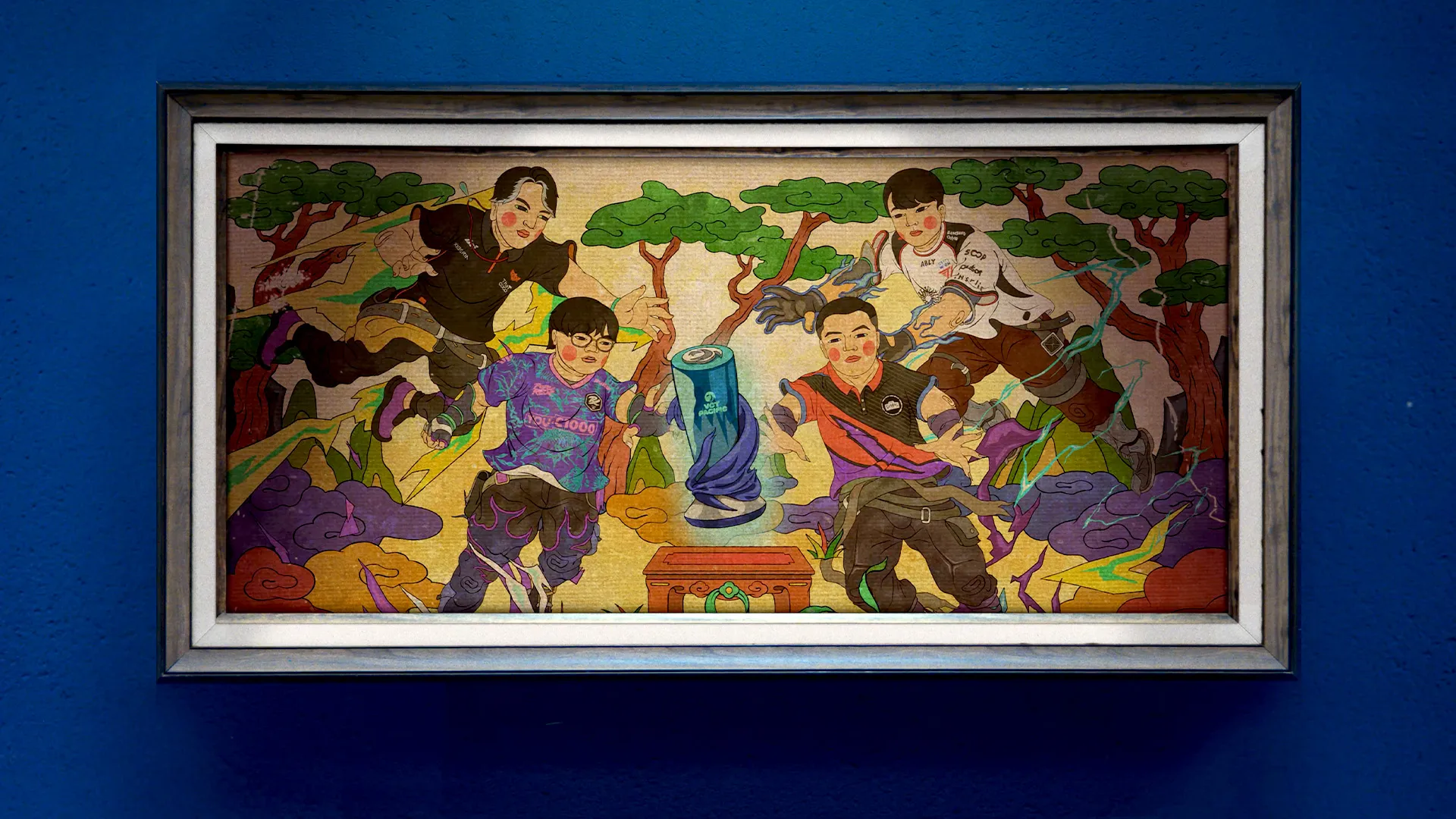
When Core-A Studios began developing BATTLE FOR GLORY, the VCT Pacific Ho Chi Minh Opening Tease, the challenge was not simply to make Vietnam recognizable. The film needed to feel unmistakably connected to its host city while still functioning as a high-energy esports narrative for a regional audience. The easiest route would have been to rely on familiar Vietnamese imagery: lotus flowers, conical hats, food, landmarks, or street scenes. There is nothing inherently wrong with those references, but recognition alone was not enough. If the cultural layer could be swapped for another country while the story remained exactly the same, then culture was still functioning as decoration. The more useful question for our creative team became: not “how do we make this look Vietnamese?” but “what in Vietnamese culture can actually help us tell the story?”
Choose a storytelling language, not just a cultural symbol
For Core-A Studios, that distinction became central to the creative development of the VCT Pacific film. Water puppetry and the visual language of Đông Hồ offered more than recognizable Vietnamese imagery; they gave us systems through which the story itself could move. A lotus flower can immediately signal Vietnam, but it does not necessarily change the structure of a film. Water puppetry does. It is already built around characters, movement, conflict, performance, and spectacle which many of the same ingredients an esports opening tease needs. Đông Hồ-inspired illustration offered a different graphic logic of shape, composition, texture, and character. Rather than placing traditional Vietnamese culture beside VALORANT as two separate visual worlds, the goal was to allow one to become the language through which the other emerged. Once a cultural reference begins influencing transitions, narrative structure, and visual rhythm, it stops being styling and starts becoming part of the creative system.
Cultural authenticity is not about maximizing recognition
In international commercial and esports production, creative teams often gravitate toward cultural references that global audiences can understand immediately. The risk is that a project about a place begins to be designed around an outsider’s image of that place. Local audiences see their own culture at a much higher resolution. They can tell when a reference has context and when it has simply been selected because it is broadly recognizable. That does not mean authentic cultural storytelling needs to be obscure. Familiar imagery can still be the right choice. The question is whether it contributes something beyond identification. For BATTLE FOR GLORY, Core-A Studios wanted to find references that felt specific and meaningful to a Vietnamese audience while remaining visually and emotionally legible to viewers across VCT Pacific. The cultural layer did not need to be explained; it needed to work as storytelling.
Local culture should be allowed to change the creative
For Core-A Studios, culturally specific production is not about developing a global concept first and asking a local team to validate it afterward. Working with Vietnamese production partners and artists on BATTLE FOR GLORY brought a different kind of creative intelligence into the process: what feels contemporary, what feels overly literal, what reflects a dated outsider image of Vietnam, and how traditional references can be reinterpreted without becoming an aesthetic filter. This kind of collaboration matters because a host city should do more than appear in the work as a setting. It should leave fingerprints on how the work is conceived and produced. If the same concept can move to another country and only the cultural assets need to change, then the location probably never had much authorship in the first place.
Rejecting the obvious does not mean familiar symbols should always be avoided. Nor is it about finding the most niche cultural reference possible. It is simply the willingness to ask one more question before choosing an image because it is easy to recognize: what is it doing for the story?
That became one of the main creative lessons for Core-A Studios while producing the VCT Pacific Ho Chi Minh Opening Tease. Cultural authenticity did not come from putting enough “Vietnamese” things on screen. It came from allowing Vietnam to influence the visual language and narrative logic of the film itself.
For us, that is the difference between localization and cultural storytelling. Localization can tell an audience where a piece of content belongs. Cultural storytelling allows that place to change what the content becomes.
With BATTLE FOR GLORY, the goal was never simply to create an esports film that looked like it had been made in Vietnam. It was to create a piece that could only have become this version of itself because Vietnam was part of the creative idea from the beginning.